 English
 中文简体
中文简体 Español
 عربى
عربىNews
Home / News / Industry News / Curtain Fabric Guide: Choosing the Right Material, Weave, and Drape for Windows

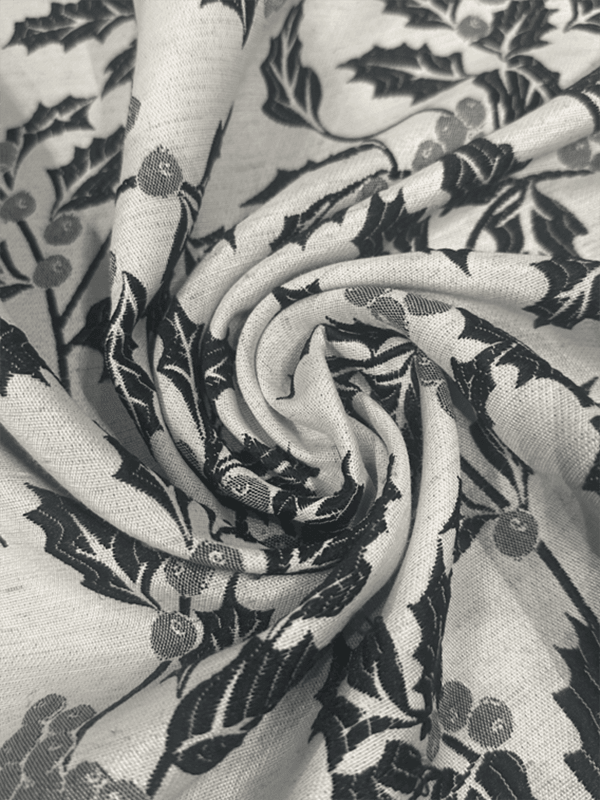
Curtain Fabric Guide: Choosing the Right Material, Weave, and Drape for Windows
Oct 13,2026
Cotton Fabric Guide: Types, Weaves, and How to Source It Right for B2B
Oct 08,2026
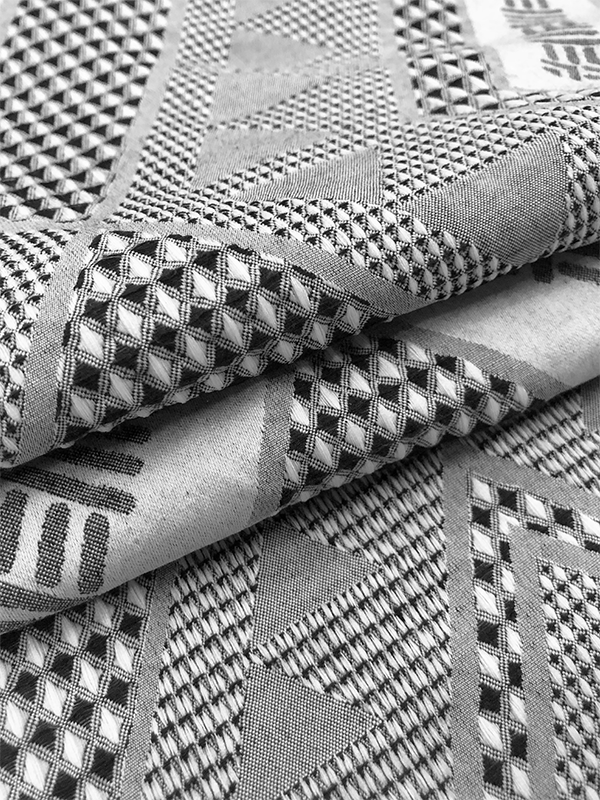
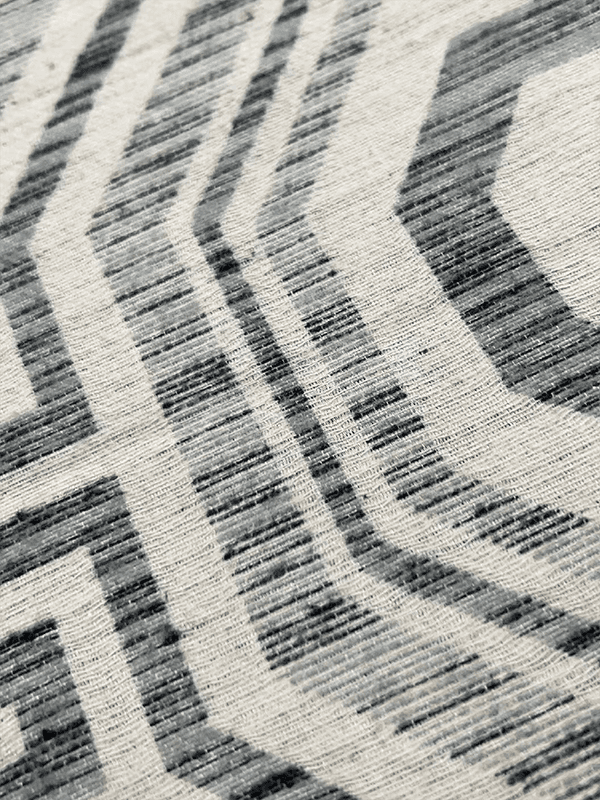
Black and White Diamond Patterned Bedding Fabric | Custom Waffle Weave
Sep 29,2026
Cotton and Polyester Fabric: A Complete Guide to Blends, Benefits, and Care
Sep 21,2026
Bedding Fabric Explained: Cotton, Polyester & Blends for Buyers and Manufacturers
Sep 15,2026Content
Curtain fabric looks like a simple purchase until you sit down with a specification sheet. Weight, weave, fiber content, pattern repeat and light control all pull against one another, and a decision that solves one problem can quietly create another. We have been weaving decorative fabrics for bedding, sofa and window applications since 2006, and the questions buyers ask about drapery cloth have barely changed in that time. What follows is the advice we give most often, from material selection through the practical details that decide whether a fabric still looks right a year after it has been sewn, pleated and hung.
Drapery and upholstery are often discussed in the same breath, but they ask very different things of a cloth. A sofa fabric is judged by abrasion resistance and how it survives constant friction. A curtain fabric is judged by how it falls, how it manages light, and whether it still hangs in clean vertical folds long after installation.
That leaves three properties that matter more than anything else:
Pattern and color come after these, not before. A beautiful print on a cloth that sags at the hem is still a problem for the end customer.
Two families do most of the work in curtain production: 100% polyester and polyester blended with linen. Both are widely available, both can be finished in a broad spread of patterns, and both behave quite differently once made up.
| What matters | 100% polyester curtain fabric | Polyester and linen blend |
|---|---|---|
| Drape and hand | Fluid and consistent; holds pleats crisply | Softer, slightly drier hand with natural texture |
| Surface look | Smooth to highly detailed, with strong color clarity | Matte, gently irregular slub appearance |
| Wrinkle recovery | Excellent; resists creasing in storage and transit | Moderate; creases relax gradually after hanging |
| Light handling | Easier to engineer for room darkening when tightly woven | Soft diffusion; usually filters rather than blocks |
| Pattern capability | Fine detail, large repeats, high-precision jacquard effects | Reads best with botanical and loose organic motifs |
| Care | Machine washable, quick drying and low fuss | Gentle wash, lower heat, more careful handling |
Choose polyester when consistency, easy care and precise pattern detail drive the brief. Choose a linen blend when the room calls for warmth and a natural surface, and when the buyer accepts a little more care in exchange for that character.
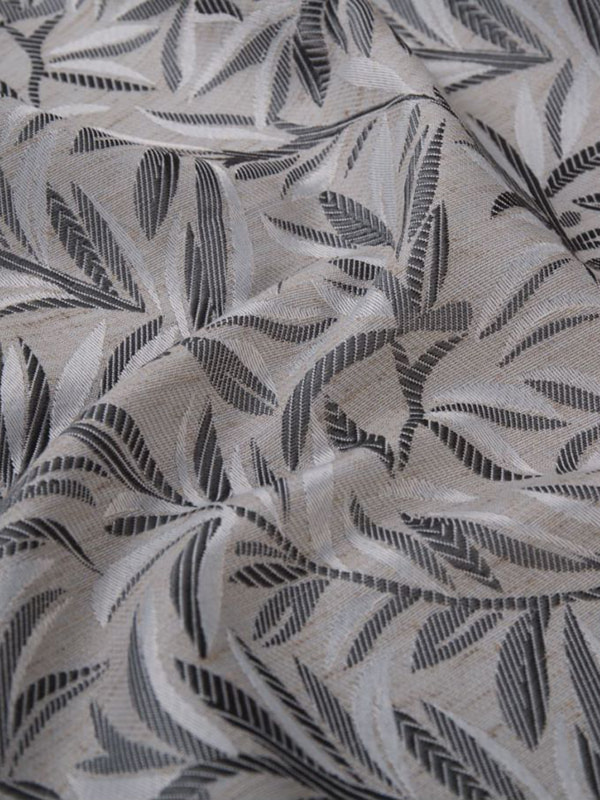 Bamboo leaf polyester linen curtain fabricCOMPOSITION: 95%polyester 5%linenView Product →
Fiber content sets the baseline, but the loom decides much of what a customer actually sees and feels. Three construction directions come up again and again in curtain programs.
Dense warp and weft counts produce a tight, even surface with crisp edges and clear pattern definition. The tighter structure is also more opaque, which helps when a project needs a little more privacy without a separate lining. Botanical and geometric designs hold their shape particularly well on this construction, which is why high-precision weaving is a common choice for statement windows in living rooms and hotel lobbies.
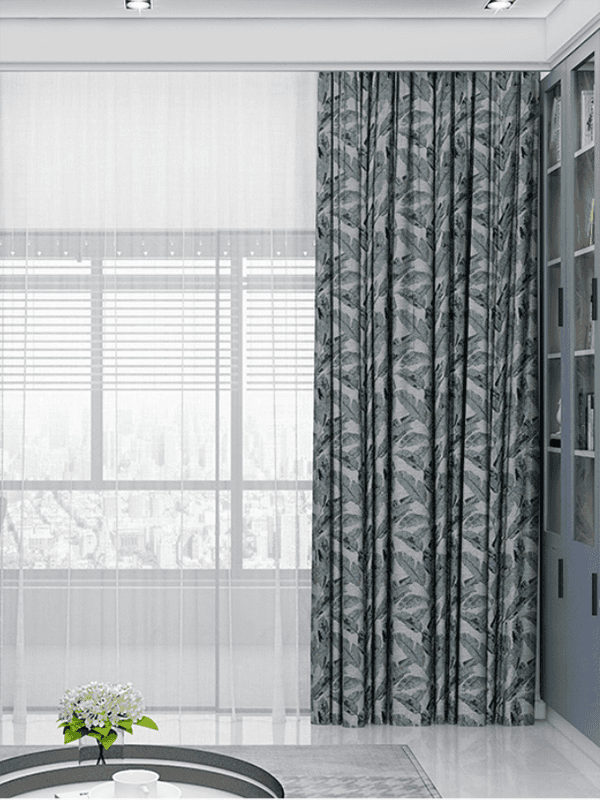 Banana leaf high-precision polyester curtain fabricCOMPOSITION: 100%polyesterView Product →
Jacquard construction builds the motif into the cloth rather than printing it on top, so the pattern has a subtle relief and depth that does not fade away with washing. It suits generous repeats, gradient effects and stylized foliage, and it gives a room a focal point without additional trim.
Textured yarns add body, hide everyday marks and create a softer, more tactile surface. Crepe and washed finishes bring a relaxed, matte character that works well in bedrooms and casual living spaces, where a high sheen would feel out of place.
It helps to separate what a fabric does on its own from what a lining adds. Most decorative drapery cloth falls into two broad categories:
Color is part of the calculation too. Pale fabrics reflect more light back into the room and feel airier; deep tones absorb light and make a window feel more solid and grounded. Neither is better — it depends on whether the customer wants the window to disappear into the room or to act as its anchor.
Pattern scale should follow the architecture, not the other way around. Tall ceilings and wide windows carry large repeats comfortably, while compact rooms are usually better served by small geometrics, fine stripes and restrained repeats. Color should connect with the fixed elements already in the space, such as flooring and wall tone, so the drapery reads as part of the scheme rather than an addition to it.
Coordinating across a room is easier when the drapery, bedding and upholstery fabrics come from the same mill, because dye lots and finishing treatments can be aligned from the start. If you are weighing how a specific cloth will behave in a particular room, our notes on selecting and applying curtain fabrics walk through the same trade-offs from a design perspective.
 European style crown flower polyester curtain fabricDate: All prices are valid for 15 days.View Product →
Most curtain complaints trace back to handling rather than weaving. A few habits prevent the majority of them:
Where pleating is involved, allow the fabric to relax for a day or two after unrolling before it is cut. Relaxed cloth pleats more evenly and holds its heading shape longer.
For buyers building a collection rather than furnishing a single room, working with the manufacturer shortens both the development loop and the supply chain. As a fabric factory manufacturer, Zhejiang OSD Textile Co., Ltd. operates more than 200 machines and an in-house design department that releases new designs monthly. Our curtain range is organized the way buyers actually specify: first by application, then by composition, covering 100% polyester and polyester-linen blends.
Ordering directly also supports OEM and ODM work. Customers can send a drawing, a reference sample or a target hand feel, and the development team builds the construction around it — including custom pattern repeats, color matching and finishing. Products ship to the United States, Europe, Australia, India and other markets, and our team is happy to advise on which construction suits a given window before a single meter is woven.
Good curtain fabric is not simply the most attractive cloth in the sample book. It is the one whose weight suits the track, whose weave handles the light in the room, and whose fiber content matches how the customer is willing to care for it. Get those three right, and the pattern becomes a pleasure rather than a risk. Start with the window, then choose the cloth — and when in doubt, request a sample and hang it in daylight before committing to a production run.
Your email address will not be published. Required fields are marked *
 Phone: +86-13362131543
 E-mail: [email protected]
E-mail: [email protected]
 Address: No 3 Zhongyuan RD.,Shenshi Lianmeng Industrial Zone,Xucun Town,Haining,Zhejiang,China
Copyright © Zhejiang OSD Textile Co., Ltd. All Rights Reserved.
