 English
 中文简体
 Español
 عربى
News
Home / News / Industry News / Bedding Fabric Guide: How Fiber, Weave and Finish Shape Sheets and Duvets

Bedding Fabric Guide: How Fiber, Weave and Finish Shape Sheets and Duvets
Nov 12,2026
Hexagonal Interwoven Polyester Cotton Bedding Fabric: A Practical Buyer's Guide
Nov 03,2026
Inside a Cotton Fabric Factory: How Cotton Becomes Fabric and How Buyers Source It
Oct 26,2026
Cotton Fabric Suppliers: A Practical Sourcing Guide for Home Textile Buyers
Oct 19,2026
Curtain Fabric Guide: Choosing the Right Material, Weave, and Drape for Windows
Oct 13,2026Content
Walk into any bedroom and the first thing your hand reaches for is fabric — the sheet pulled tight across the mattress, the duvet cover, the throw folded at the foot of the bed. Bedding fabric is the part of a room people actually touch, and it decides whether a bed feels cool and crisp or soft and cocooning. At Zhejiang OSD Textile, we have been producing fabrics for beds, windows and sofas since 2006, and bedding remains the category we discuss with customers most often.
This guide walks through what bedding fabric really is, how fiber and weave change the way it behaves on the bed, and what to check before committing to a sampling round or a production order.
Bedding fabric is any textile woven or knitted specifically for use on a bed. It is defined less by one construction than by a set of expectations: it has to sit against skin for eight hours at a time, survive frequent laundering, hold its colour, and still look presentable when a room is shown to guests or photographed for a catalogue.
The category covers a wide family of products:
Because each item does a different job, the same fiber can behave quite differently depending on how it is woven and finished. That is why experienced buyers rarely ask only "what is it made of?" — they ask what it is made of and how it was put together.
Most bedding programs are built on one of three foundations. Understanding the trade-offs between them is the fastest way to shortlist a fabric.
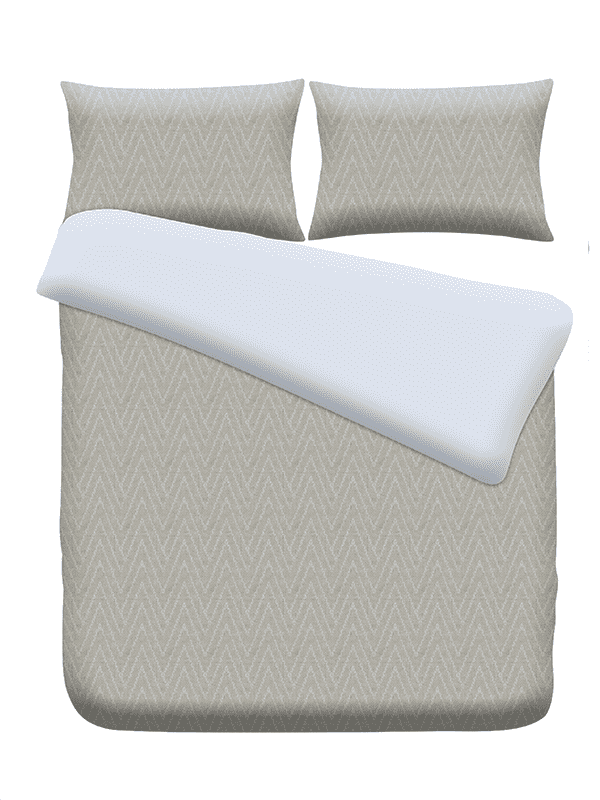
Cotton is the benchmark for hand feel. It breathes, absorbs moisture and softens with repeated washing, which is why it dominates the mid-to-premium sheet market. The trade-off is care: cotton can shrink on the first wash and creases unless it is pressed or treated. Within cotton alone, the range is enormous — a plain percale-style weave feels completely different from a textured, interwoven geometric cloth, and both can sit under the same fiber heading.
 Cotton Checkered Interwoven Wavy Bracket Bedding FabricA 100% cotton, 210gsm bedding fabric with small interwoven squares forming layered wavy brackets in white and yellow, showing cotton’s textured design range.View Product →
Polyester earns its place through consistency. It resists wrinkles and pilling, dries quickly, holds pigment well and keeps its price stable across large orders. Modern polyester bedding is far removed from the slick, clammy fabric of twenty years ago; brushed, crepe, waffle and chenille-style constructions give it genuine texture, and sand-washed or wrinkled finishes add a softer, lived-in surface.
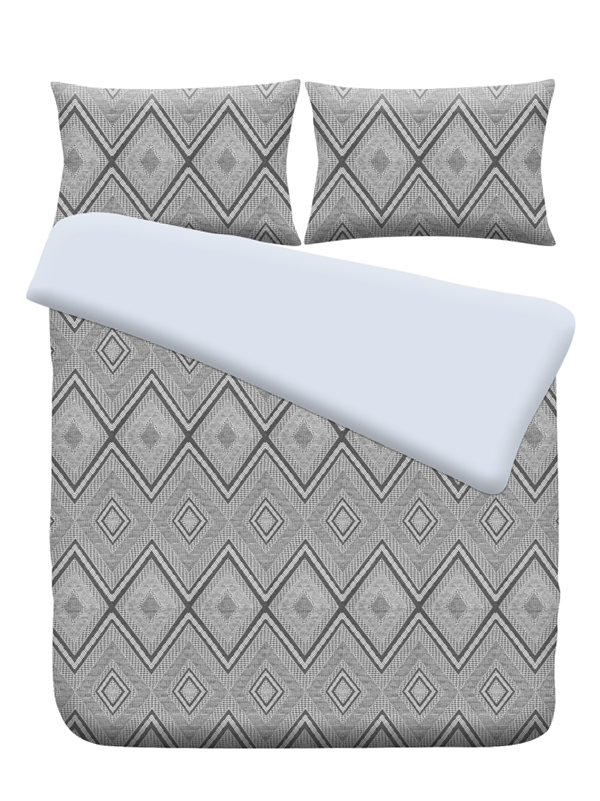 Black and White Diamond Waffle Polyester Bedding FabricA 100% polyester, 150gsm waffle fabric in a black-and-white diamond grid, with OEKO-TEX Standard 100 certification and easy-care washing guidance.View Product →
Blends exist to balance the two. A polyester-cotton cloth keeps much of cotton's pleasant dry handle while gaining polyester's shape retention and easy care — a combination that suits hospitality bedding, high-turnover retail ranges and anything that will be washed far more often than a private home would ever manage.
| Fiber base | Hand feel | Durability | Care | Typical use |
|---|---|---|---|---|
| 100% cotton | Soft, breathable, dry touch | Good; softens with washing | Warm machine wash; may shrink first wash | Sheets, duvet covers, pillowcases |
| 100% polyester | Smooth, cool, light | High; resists wrinkles and pilling | Low heat, quick drying | Value sheet sets, printed covers, throws |
| Poly-cotton blend | Balanced, slightly crisper | High; holds shape well | Simple; minimal ironing | Contract bedding, quilts, printed ranges |
Fiber sets the baseline, but weave and finishing decide the personality of a bedding fabric. A tight, balanced plain weave reads as crisp and hotel-like; a looser or textured construction feels airier and more decorative. Heavier weights drape with more presence and suit duvet covers and bedspreads, while lighter weights sit better in sheets and summer covers.
Surface structure does the rest. Waffle grids, crepe effects, chenille yarns, sand-washed finishes and raised tufted patterns all change how light falls on the cloth and how it feels under the palm. Our own notes on how weave affects texture and performance go deeper into this, and it is a point worth raising early with any mill, because a pattern change often means a construction change too.
Finishing also carries practical weight: softeners improve handle, sanforising controls shrinkage, and brushing adds warmth. These are rarely visible in a photograph, but they show up clearly after the fifth wash.
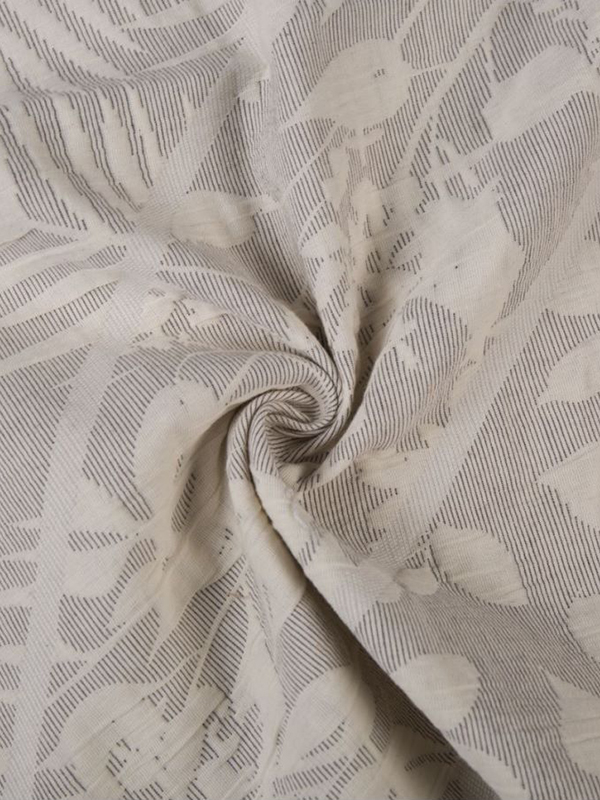
 European Damascus Sand-Washed Wrinkled Polyester Bedding FabricA 230gsm, 100% polyester bedding fabric with a European Damascus floral pattern and sand-washed, wrinkled finish that adds decorative texture and visual depth.View Product →
Once fiber and construction are clear, the next question is fit for purpose. A cloth that makes a beautiful duvet cover may be a poor choice for a fitted sheet, and vice versa.
Prioritise smoothness, breathability and dimensional stability. Light-to-medium weights in cotton or poly-cotton work well; anything too heavy will feel stiff against skin and resist tucking neatly at the corners.
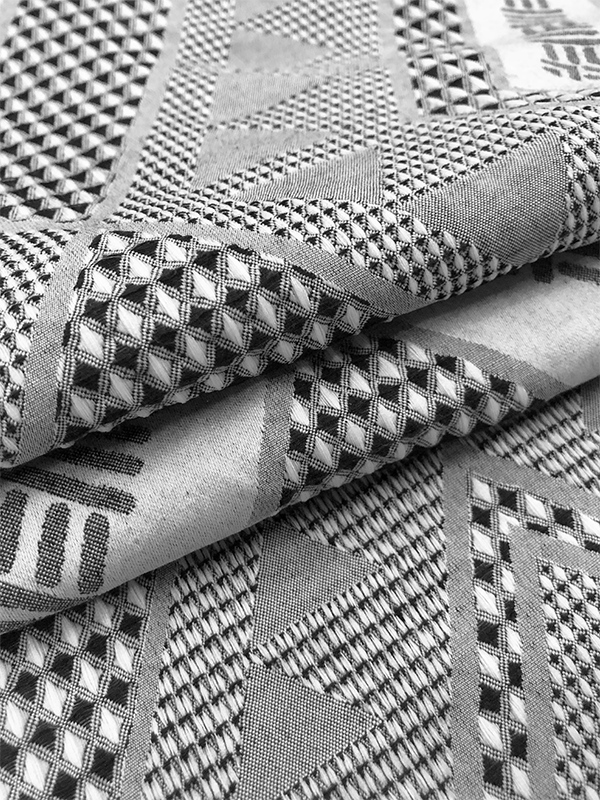
Here you can afford more body and more pattern. Structured interweaves, jacquard effects and deeper textures give a bed visual weight, and they hide creasing far better than a flat plain cloth. Patterned poly-cotton constructions — geometric cuts, coin and tile motifs, deep tufted rectangles — are especially popular because they photograph well and hold their shape through repeated washing.
Texture leads. Chenille, waffle and air-layer constructions are chosen for warmth and tactile appeal, and they are forgiving of the slight irregularities that come with fancy yarns.
If you would rather browse by category than by fiber, our full bedding fabric collection is organised by cotton, polyester and poly-cotton so you can compare constructions side by side.
Most costly surprises in bedding production trace back to questions that were never asked at the sampling stage. These are the ones we raise with customers before a single meter is woven:
Care expectations matter too. A fabric sold as easy-care should genuinely need little ironing; a cotton marketed on softness should not arrive stiff and scratchy. Testing a sewn sample through several home washes tells you more than any specification sheet.
Bedding is a category where small details compound across a large order, so the relationship with the mill matters. We run more than 200 machines from our base in Zhejiang and have supplied bedding, curtain, home textile and upholstery fabrics to buyers in the United States, Europe, Australia and India. Our design team releases new patterns monthly, and we work from customer drawings or physical samples when a range needs to be developed from scratch.
In practice that means a buyer can send a reference swatch, discuss hand feel and weight, and receive a development proposal rather than a catalogue number. We also quote directly as a factory, which keeps cost conversations straightforward — and if something goes wrong after delivery, we would rather hear about it than not. Every problem, large or small, gets worked through with the customer.
Good bedding fabric is not the most technical cloth on the market; it is the one that matches its job. Start with the fiber base, narrow it down by weave and finish, then confirm the practical details — shrinkage, pilling, care, compliance — before the order is placed. Do that in the right order and the rest of the process tends to run smoothly.
If you are weighing up options for an upcoming range, we are always happy to talk through what has worked for similar programs and what has not.
Your email address will not be published. Required fields are marked *
 Phone: +86-13362131543
 E-mail: [email protected]
 Address: No 3 Zhongyuan RD.,Shenshi Lianmeng Industrial Zone,Xucun Town,Haining,Zhejiang,China
Copyright © Zhejiang OSD Textile Co., Ltd. All Rights Reserved.
