 English
 中文简体
 Español
 عربى
News
Home / News / Industry News / How Do You Choose Between Cotton and Polyester Fabric for Home Textiles?


How Do You Choose Between Cotton and Polyester Fabric for Home Textiles?
Nov 19,2026
Bedding Fabric Guide: How Fiber, Weave and Finish Shape Sheets and Duvets
Nov 12,2026
Hexagonal Interwoven Polyester Cotton Bedding Fabric: A Practical Buyer's Guide
Nov 03,2026
Inside a Cotton Fabric Factory: How Cotton Becomes Fabric and How Buyers Source It
Oct 26,2026
Cotton Fabric Suppliers: A Practical Sourcing Guide for Home Textile Buyers
Oct 19,2026Content
Almost every conversation we have with a buyer eventually circles back to one question: cotton or polyester? After close to twenty years of weaving both, our honest answer is that neither fiber wins on its own. What settles the matter is the product the fabric has to serve — a duvet cover that should feel cool through the night, a curtain that has to hold a large-scale print for years, a sofa cover that takes daily wear without sagging out of shape.
This guide walks through how the two fibers behave, where blends of cotton and polyester sit between them, and how we pick constructions and finishes for bedding, curtains, upholstery and blankets. It is written from the mill floor rather than from a marketing deck, and we have tried to keep the trade-offs visible instead of smoothing them over.
Cotton is a natural cellulose fiber. It breathes, it absorbs moisture rather than letting it sit on the skin, and it takes dye deeply, which is why prints and yarn-dyed stripes look rich on a cotton ground. It also softens with every wash, which many people find is the real reason they keep coming back to it. The trade-offs are equally real: cotton shrinks unless it is pre-shrunk or finished carefully, it creases, it takes longer to dry, and its price moves with the harvest.
Polyester is synthetic and behaves like an engineered material. It is strong for its weight, holds its shape, dries quickly, resists wrinkling and keeps color well after repeated washing. Tightly woven polyester, however, is less breathable, can feel slick or slightly clammy in humid weather, and in some constructions will pill unless the yarn and finishing are controlled. It is also petroleum-based, which matters to buyers with sustainability targets.
In the finished fabric, these differences show up in practical ways. A cotton sheet feels cool and gets softer each season. A polyester sheet feels smooth from day one and comes out of the dryer nearly wrinkle-free. Neither description is better; they simply suit different customers, different climates and different price points.
The table below compares the two fibers the way a buyer actually experiences them — after the fabric has been cut, sewn, washed and used a few dozen times.
| Property | Cotton | Polyester | Cotton-polyester blend |
|---|---|---|---|
| Hand feel | Soft, dry, gets softer with washing | Smooth to slightly slick; depends on finishing | Cotton touch with a crisper body |
| Breathability | High in standard weaves | Lower in dense weaves; improved by open structures | Moderate, tunable through weave |
| Moisture handling | Absorbs and releases slowly | Wicks and dries fast, holds little water | Absorbs some, dries faster than pure cotton |
| Durability | Good, weaker when wet | Excellent abrasion and tensile strength | Strong, with longer service life than cotton alone |
| Wrinkling | Creases readily | Resists creasing | Fewer wrinkles, easier pressing |
| Shrinkage | Noticeable unless pre-shrunk | Minimal | Low, one of its main selling points |
| Color and print | Deep, rich dye uptake | Good colorfastness; fine detail prints well | Reliable shade consistency across lots |
| Care | Machine wash, medium heat, benefits from ironing | Easy care, low ironing, avoid high heat | Simple care, quick line dry |
| Cost stability | Follows crop prices | Follows energy and petrochemical prices | Usually the most predictable to budget |
A fiber content label, in other words, tells only part of the story. We have brushed polyester fabrics that customers mistake for cotton at first touch, and tightly woven cotton qualities that feel crisp and almost linen-like. Yarn, weave and finishing do as much work as the fiber itself.
Mixing the two fibers is not a compromise so much as an engineering decision. Blending lets us keep the cotton hand and moisture behavior while borrowing polyester's strength, shape retention and quick drying. In practice, most home textile programs settle on one of three ratios:
The same logic travels across constructions: poly-cotton twill for structure, poplin for a smooth surface, jersey knit for stretch, and brushed or fleece versions where warmth matters more than breathability. We have written a longer note on the reasoning behind blending cotton and polyester for home textiles if you want the detail behind those choices.
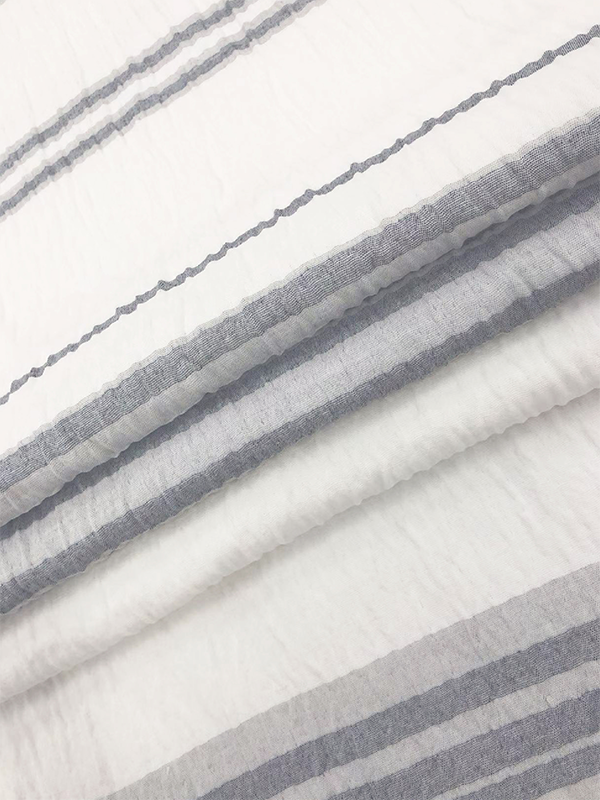
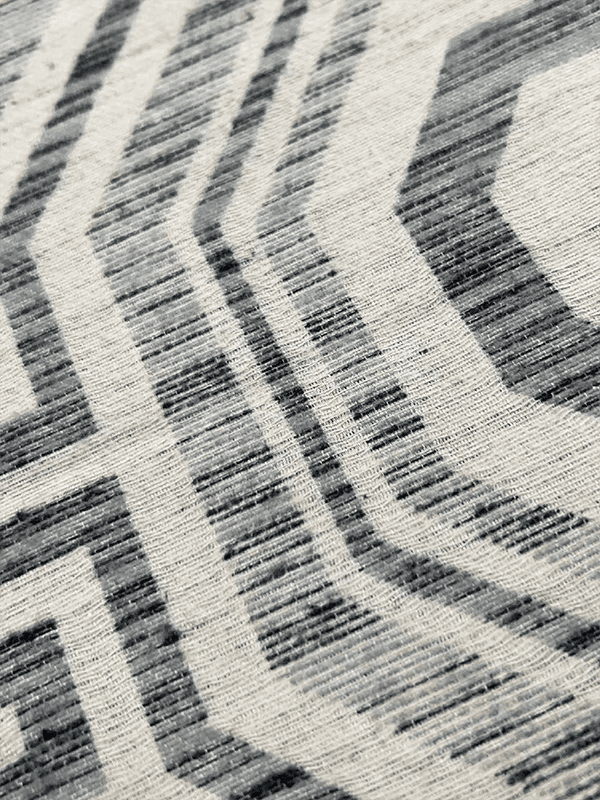
For bedding, cotton still leads where sleep comfort is the priority — a plain-weave or sateen cotton breathes and softens beautifully. Polyester suits programs where wrinkle resistance, print detail and quick laundering matter, such as hospitality or student housing. Blends sit neatly in between, and this is where much of our development work happens: geometric cuts, waffle structures, tufted textures and small repeating motifs that hold their shape wash after wash.
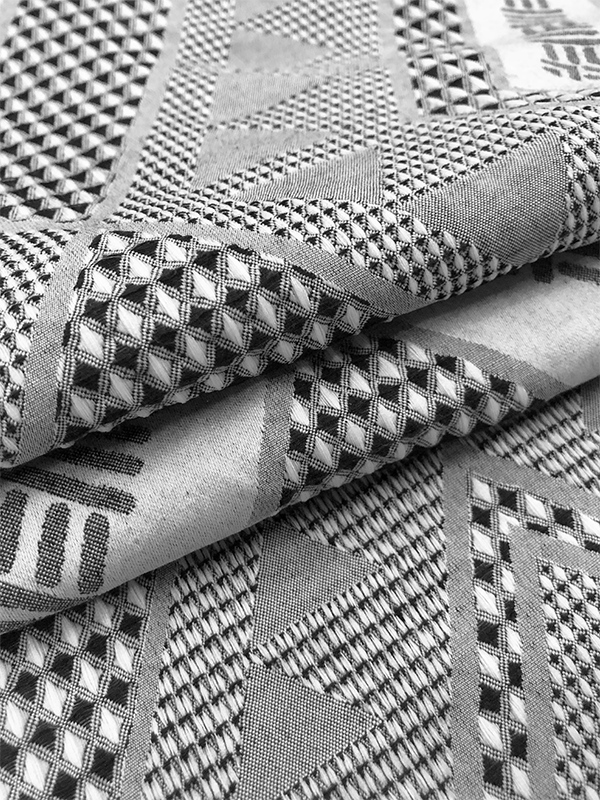
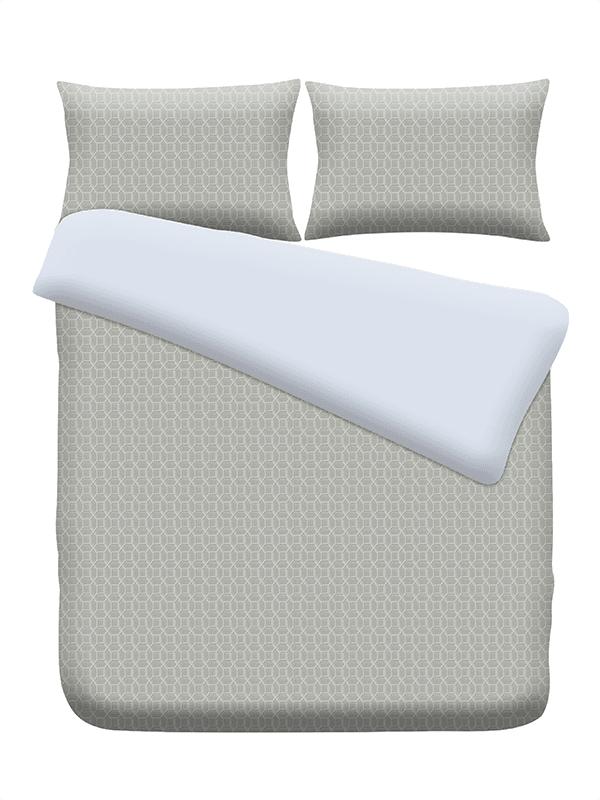 Copper Coin Poly-Cotton Bedding FabricA 370gsm poly-cotton bedding fabric with connected hexagon and square motifs in gray and white, designed for a clean, dimensional bed linen look.View Product →
Curtains ask for dimensional stability, light fastness and the ability to hold a large repeat cleanly. That is why polyester and polyester-linen qualities dominate the category, from high-precision botanical designs to interwoven geometric stripes. A cotton-rich curtain is possible, but it will crease and can sag under its own weight unless it is lined and finished with care.
Upholstery is an abrasion problem first and a comfort problem second. Polyester and poly-cotton chenille, textured yarn and interwoven structures give us the surface interest designers want while keeping the cover in shape through years of use. Where a softer hand is required, we build that in through yarn selection rather than by adding cotton alone.
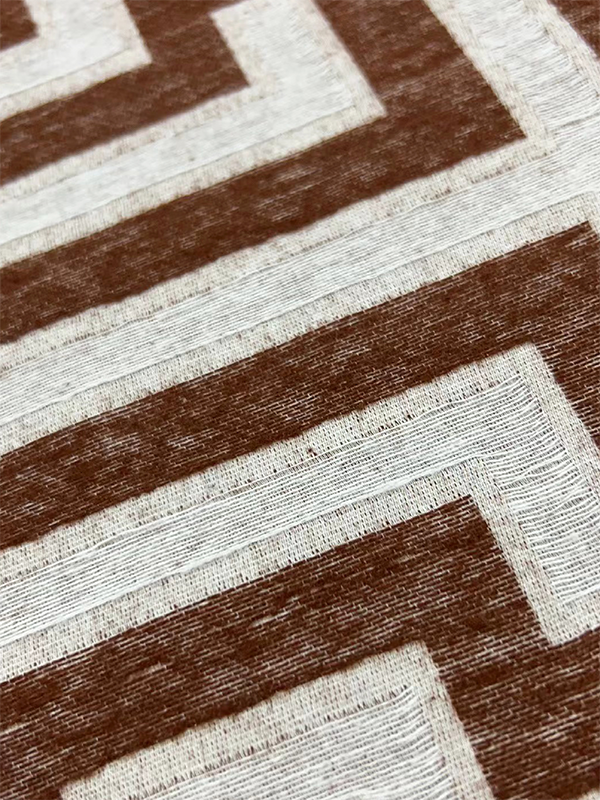
Blanket programs are a good example of blending done well: the cotton component keeps the fabric from feeling synthetic against the skin, while polyester carries the bulk, the chenille texture and the color depth. Our blanket series covers waffle grounds, mud-dot patterns, herringbone chenille and retro ethnic motifs, all built on poly-cotton constructions.
 Brown-White Chenille Blanket Fabric SeriesA 300gsm poly-cotton chenille with interwoven brown and white patterns, suited to soft, durable blankets and home textile accents.View Product →
Jacquard is where fiber choice and design ambition meet. Because the pattern is created in the weave rather than printed on top, it survives washing and abrasion far better than a surface print, and it gives the fabric a subtle relief that photographs well. Jacquard works in pure cotton for a matte, natural look, in pure polyester for crisp definition, and in blends for a balance of both.
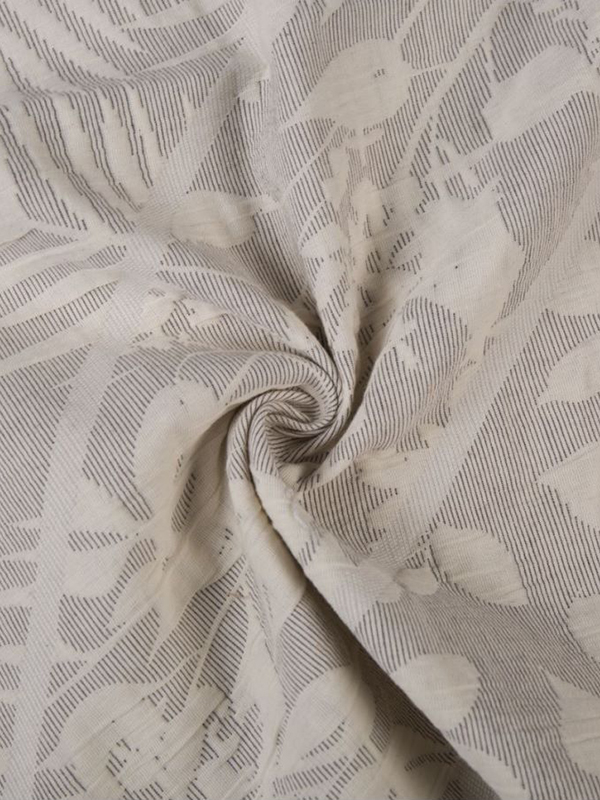
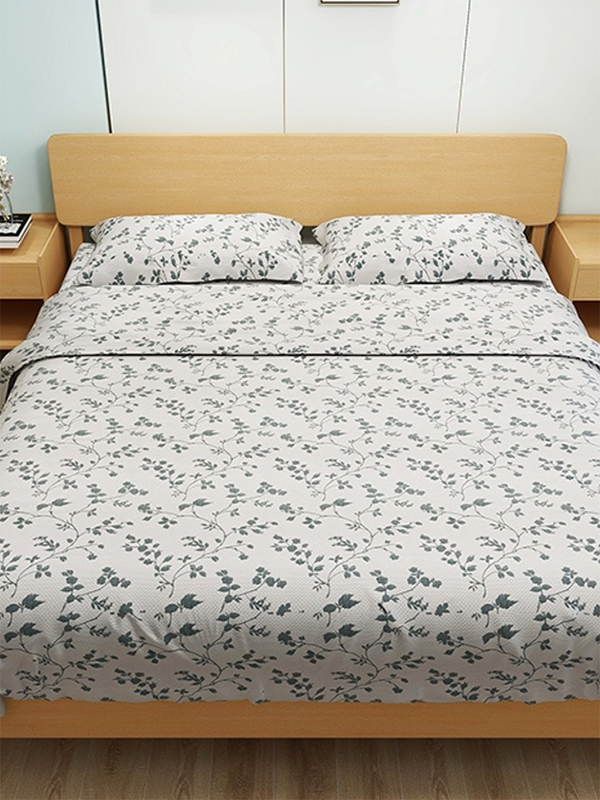 Cherry Blossom Poly-Cotton Jacquard FabricA 255gsm poly-cotton jacquard with a layered cherry blossom design, offering a soft, stable hand for floral textile programs.View Product →
Finishing is the step buyers underestimate most. Sanforizing controls shrinkage, sand washing softens the surface and slightly lifts the color, brushing creates warmth and a softer touch, and a silicone softener can make a polyester-rich fabric feel noticeably closer to cotton. Two fabrics with identical fiber content can therefore arrive at completely different hands, and that is usually a finishing decision rather than a fiber one.
For care instructions we generally advise the following, and we are happy to adjust them to the specific quality you order:
We have been producing fabric since 2006, with more than 200 machines running bedding, curtain, home textile, jacquard and sofa qualities for buyers in the United States, Europe, Australia, India and beyond. Our design department releases new patterns every month, and we work in both OEM and ODM modes: send a sketch, a reference sample or a finished product, and we will suggest constructions, fiber ratios and finishes that meet the target price without quietly downgrading the hand feel.
Because we quote directly from the factory, the conversation about cost stays concrete — what a heavier yarn, a wider repeat or a softer finish actually adds per meter. You can browse our fabric catalogue by application and fiber content, or simply tell us what the finished product needs to do.
If there is one takeaway from all of this, it is that cotton and polyester fabric are tools rather than rivals. Cotton brings breathability, softness and a natural hand; polyester brings strength, stability and easy care; blends let you dial in exactly how much of each you need. The right answer usually becomes obvious once you describe the product, the market and the price point — and that is a conversation we are always glad to have.
Your email address will not be published. Required fields are marked *
 Phone: +86-13362131543
 E-mail: [email protected]
 Address: No 3 Zhongyuan RD.,Shenshi Lianmeng Industrial Zone,Xucun Town,Haining,Zhejiang,China
Copyright © Zhejiang OSD Textile Co., Ltd. All Rights Reserved.
