 English
 中文简体
中文简体 Español
 عربى
عربىNews
Home / News / Industry News / How Do You Choose the Right Curtain Fabric for Every Window in Your Home?

Bedding Fabric Explained: Cotton, Polyester & Blends for Buyers and Manufacturers
Sep 15,2026
Bedding Fabric Guide: Cotton, Polyester, and Blended Options for Buyers
Sep 08,2026
How Do You Choose the Right Sofa Upholstery Fabric?
Sep 01,2026
How Do You Choose the Right Sofa Upholstery Fabric for Your Home?
Aug 25,2026
How Do You Choose the Right Curtain Fabric for Every Room?
Aug 19,2026Content
Curtains do far more than dress a window. The fabric you choose controls how much light enters a room, how much privacy you have, how well the curtain hangs, and how long it will last before fading or wearing out. A fabric that looks beautiful in a showroom can disappoint in a west-facing living room that gets hours of direct afternoon sun, or fail completely in a steamy bathroom where humidity is constant. Getting the choice right means thinking about function first and aesthetics second — or at least equally. This guide covers the most common curtain materials, their practical strengths and weaknesses, and how to match them to the specific demands of each room in your home.
Before comparing individual materials, it helps to understand the performance criteria that matter most. Every curtain fabric can be assessed across the same set of practical dimensions, and knowing these makes it much easier to filter your options quickly.
The fabric market for curtains is wide, but most options fall into a manageable number of categories. Understanding the core characteristics of each helps you narrow your shortlist quickly.
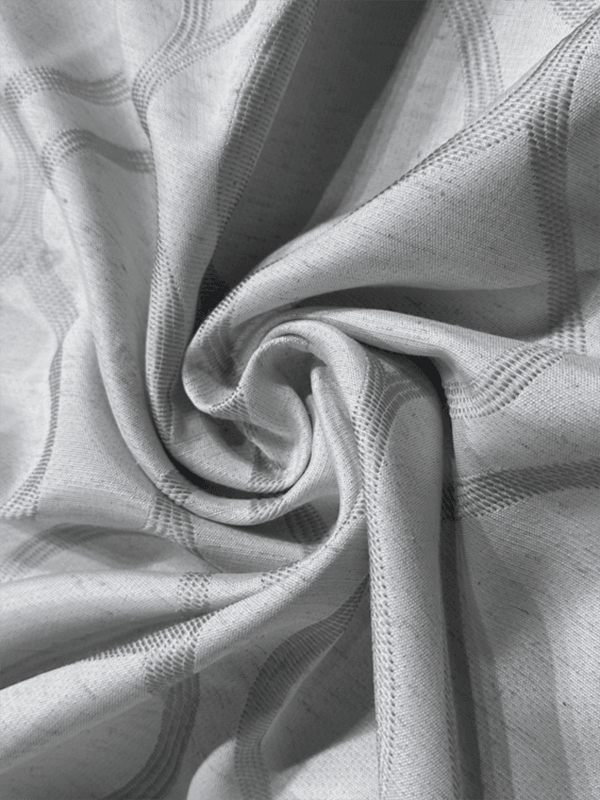
Cotton is one of the most versatile curtain materials available. It comes in a broad range of weights, from lightweight voile to dense canvas, and it takes dye well, which means you will find it in virtually every colour and print imaginable. Cotton hangs cleanly, is relatively easy to wash at home, and is breathable enough for kitchens and living areas. The main drawback is that untreated cotton fades noticeably in direct sunlight and can shrink if washed at too high a temperature. For rooms with significant sun exposure, look for cotton fabrics with a UV-resistant finish or line them with an interlining to protect the face fabric.
Linen has become one of the most sought-after curtain fabrics for contemporary interiors, and for good reason. Its natural texture adds visual interest without pattern, it filters light in a soft, diffused way that feels warm and relaxed, and it is naturally more resistant to fading than cotton. Linen does crease easily, which can be a drawback if you want a very crisp, formal look, but for casual living rooms, bedrooms, and dining rooms it has a relaxed elegance that is hard to replicate with synthetic alternatives. Pure linen can be expensive; linen-cotton blends offer a similar aesthetic at a lower price point and with slightly improved wrinkle resistance.
Velvet is a high-performance fabric disguised as a luxury one. Its dense pile construction blocks light effectively, provides excellent thermal insulation, and absorbs sound, making it particularly suitable for bedrooms, home cinemas, and formal reception rooms. It drapes beautifully in floor-length panels and has a richness that is difficult to achieve with flat-weave fabrics. The trade-offs are weight — velvet curtains are heavy and require robust tracks or poles — and care, since velvet must be handled carefully to avoid crushing the pile. It should be dry-cleaned rather than machine washed in most cases.
Real silk gives curtains an unmatched luminosity and a fluid drape, but it is expensive, deteriorates rapidly in direct sunlight, and is difficult to maintain. For most residential applications, faux silk — typically a polyester weave engineered to mimic silk's sheen — is a far more practical choice. High-quality faux silk is almost indistinguishable from the real thing at normal viewing distances, is significantly more fade-resistant, and can often be gently machine washed. Silk and faux silk work best in formal spaces away from strong sunlight: dining rooms, master bedrooms, and living rooms with good window coverage.
Sheer fabrics — including voile, organza, and fine linen gauze — are used when you want to soften light and maintain a visual connection to the outside without the full opacity of a lined curtain. They work well layered behind heavier curtains, allowing you to have full blockout when needed and a gentle filtered look during the day. On their own, sheers provide almost no privacy at night, so they are best combined with a secondary curtain layer in rooms where evening privacy matters. They are lightweight, easy to wash, and relatively inexpensive, making them a good option for casual spaces or rooms where the window is a feature to be enjoyed rather than blocked.
Polyester and synthetic blend fabrics are often dismissed as budget options, but modern versions are significantly more sophisticated than their predecessors. High-quality polyester weaves can replicate the appearance of linen, cotton, or silk at a fraction of the cost, with superior fade resistance, easier care, and greater dimensional stability. They are an excellent choice for high-traffic areas, children's rooms, rental properties, or any situation where durability and low maintenance outrank natural fibre authenticity. The main limitation is that lower-quality synthetics can look cheap and feel uncomfortable in the hand, so it is worth touching the fabric in person before ordering if possible.
The following table summarises how the main curtain fabrics compare across the key performance dimensions discussed above.
| Fabric | Light Control | Privacy | Insulation | Care | Best Rooms |
| Cotton | Moderate | Good | Moderate | Machine wash | Living room, kitchen |
| Linen | Low–Moderate | Moderate | Low | Gentle wash | Living room, bedroom |
| Velvet | High | Excellent | High | Dry clean | Bedroom, dining room |
| Faux Silk | Moderate | Good | Low–Moderate | Gentle wash | Dining room, bedroom |
| Sheer / Voile | Very Low | Low | Very Low | Machine wash | Living room (layered) |
| Polyester Blend | Moderate–High | Good | Moderate | Machine wash | Any room |
Each room in a home has its own combination of light levels, humidity, privacy needs, and style requirements. Treating each space individually — rather than choosing one fabric for the whole house — leads to far better results.
The bedroom is where light control and privacy are most critical. Velvet, blackout-lined cotton, or thermal-lined polyester blends are all strong choices. If you want a softer look during the day but full darkness at night, a double-hanging system — sheer panels behind lined curtains — gives you maximum flexibility. Avoid very lightweight fabrics as the sole window treatment in a bedroom facing east or south.
Living rooms typically benefit from layered window treatments. A linen or cotton outer curtain provides warmth and texture, while a sheer inner panel maintains privacy and light during the day. In rooms with large south- or west-facing windows, UV-resistant fabrics or interlining are worthwhile investments to prevent premature fading of furniture and flooring as well as the curtain itself.
In rooms with moisture and grease, easy-care fabrics that can be machine washed frequently are essential. Polyester blends, treated cotton, and synthetic voiles are the most practical options. Avoid velvet, silk, or untreated linen in these environments. In bathrooms particularly, look for fabrics with anti-mould or moisture-resistant treatments if curtains will be positioned close to shower areas.
Regardless of the face fabric you choose, the lining has an enormous influence on how a curtain performs. An unlined curtain, even in a heavy fabric like velvet, will allow more light through than a lined version and will not insulate as well. The three main lining options are standard lining (cotton sateen, which improves drape and provides moderate light blocking), blackout lining (which eliminates almost all incoming light), and thermal or bump interlining (a thick wadding layer stitched between face fabric and lining that dramatically improves insulation). Adding a thermal interlining to a cotton or linen curtain transforms it from a decorative feature into a meaningful contributor to your home's energy efficiency — a practical consideration worth the additional cost, particularly for older properties with single-glazed windows.
The best curtain fabric is always the one that solves the specific problems of the specific window it is dressing. Start by identifying the room's primary requirements — is it privacy, darkness, insulation, easy cleaning, or aesthetic warmth? Then shortlist the fabrics that meet those requirements, and evaluate them against your style preferences and budget within that filtered group. Order fabric samples before committing to a full order: colours change significantly under different light conditions, and the weight and drape of a fabric can only be properly assessed by holding it in your hands. Taking this systematic approach costs a little more time upfront but consistently produces results that look better, perform better, and last longer.
What Makes Jacquard Fabric Stand Out From Other Woven Textiles?
2026-06-15
Which Sofa Fabric Is Best for Your Home and Lifestyle?
2026-07-02
Your email address will not be published. Required fields are marked *
 Phone: +86-13362131543
 E-mail: [email protected]
E-mail: [email protected]
 Address: No 3 Zhongyuan RD.,Shenshi Lianmeng Industrial Zone,Xucun Town,Haining,Zhejiang,China
Copyright © Zhejiang OSD Textile Co., Ltd. All Rights Reserved.
