English
 中文简体
中文简体 Español
 عربى
عربى
Content
- 1 What Is Jacquard Fabric and How Is It Actually Made?
- 2 The Structure of Jacquard Weaves: What Creates the Pattern
- 3 Common Types of Jacquard Fabric and Their Characteristics
- 4 Brocade vs Jacquard Fabric: Understanding the Real Relationship
- 5 Side-by-Side Comparison: Brocade vs Jacquard Fabric
- 6 Fiber Content and Its Impact on Jacquard Fabric Quality
- 7 Practical Applications: Where Jacquard and Brocade Fabrics Are Used
- 8 How to Identify Genuine Jacquard Fabric When Buying
- 9 Care and Maintenance of Jacquard and Brocade Fabrics
What Is Jacquard Fabric and How Is It Actually Made?
Jacquard fabric is not a single type of textile defined by its fiber content or surface finish — it is a category of woven fabric defined entirely by the method used to create its patterns. The term "jacquard" refers specifically to textiles produced on a Jacquard loom, a revolutionary weaving mechanism invented by Joseph Marie Jacquard in France in 1804. Before this invention, the creation of complex, multicolored woven patterns required the labor of a skilled draw-boy sitting above the loom and manually lifting individual warp threads to form each row of the pattern. The Jacquard mechanism replaced this process with a system of punched cards — each card controlling the movement of individual heddles and therefore the position of individual warp threads on every single pass of the weft. This allowed one weaver to produce intricately patterned fabric of any complexity with a level of repeatability and precision that was previously impossible at commercial scale.
Modern Jacquard looms are fully computerized, replacing the original punched card system with digital programming, but the fundamental weaving principle remains unchanged: individual warp threads are controlled independently rather than in groups, allowing the weave structure to change at the level of a single thread with every weft insertion. This granular control is what gives jacquard fabrics their defining characteristic — patterns that are woven directly into the fabric structure itself rather than printed on the surface, embroidered after weaving, or applied through any surface treatment. The pattern in a jacquard fabric is inseparable from the cloth; it is structurally integrated, which is why jacquard textiles retain their pattern integrity even after years of washing, wear, and mechanical stress that would fade or damage a printed or embroidered equivalent.
The Structure of Jacquard Weaves: What Creates the Pattern
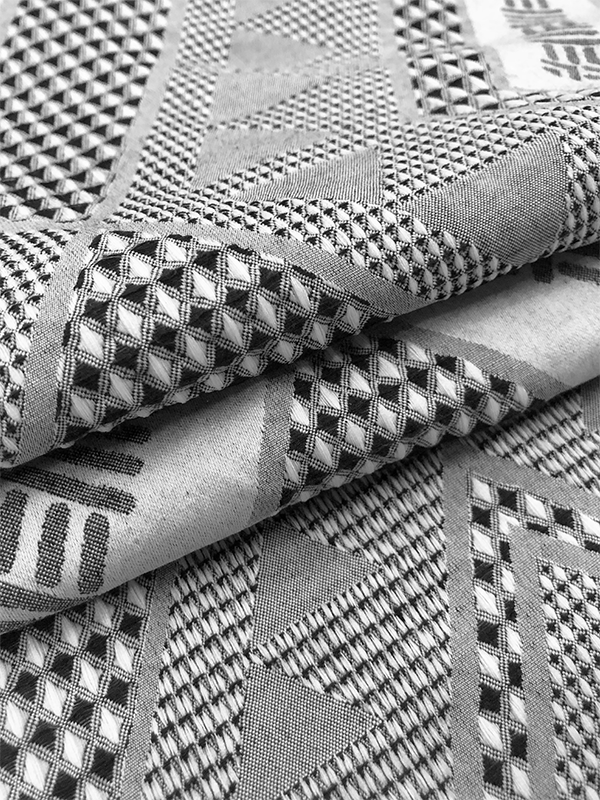
The visual patterns in jacquard fabrics are created by varying the weave structure — the specific sequence in which warp and weft threads interlace — across different areas of the cloth. In areas where warp floats predominate (long segments of warp yarn lying on top of the fabric surface), the fabric appears one way; where weft floats predominate, it appears differently. By designing the weave so that these float patterns form the outlines, fill areas, and background of a motif, the weaver can create the visual impression of a two-dimensional image or decorative design woven into a three-dimensional textile structure.
Jacquard fabrics can incorporate multiple weave structures within a single cloth — satin weave in one zone for a smooth, lustrous surface that reads as a highlight, twill weave in another for a subtle directional texture, and plain weave in the background for a matte, stable ground. This ability to blend weave structures within a single fabric is unique to jacquard production and is what gives the finest jacquard textiles their extraordinary visual depth, apparent three-dimensionality, and tonal complexity. The same fabric, viewed from different angles or under different lighting conditions, can appear to shift in color and contrast as the surface geometry interacts with light in different ways depending on which yarns are floating and which are sinking.
Common Types of Jacquard Fabric and Their Characteristics
Because jacquard refers to a production method rather than a material, it encompasses a very broad family of fabrics that differ widely in weight, hand feel, fiber composition, and intended use. Understanding the main categories within the jacquard family helps clarify the distinction between jacquard and related terms — including brocade — that are frequently confused or used interchangeably but actually describe distinct textile types.
- Damask: A self-patterned jacquard fabric woven from a single color of yarn, where the pattern is revealed entirely through the contrast between areas of warp-faced and weft-faced weave. Silk, cotton, and linen damasks are among the most historically significant jacquard textiles, used for table linens, drapery, and formal apparel.
- Brocade: A jacquard fabric enriched with supplementary weft threads — often in metallic or contrasting colored yarns — that are woven in addition to the ground structure specifically to create the raised, embossed-looking decorative motifs. Brocade is technically a subset of jacquard production, but its use of supplementary threads distinguishes it structurally and aesthetically from simpler jacquard constructions.
- Tapestry: A heavy, densely woven jacquard fabric where colored weft threads are used to build up a pictorial or decorative image across the full width of the cloth. Tapestry jacquards are characterized by their substantial weight, dimensional rigidity, and complex multicolored imagery, making them suitable for upholstery, wall hangings, and bags.
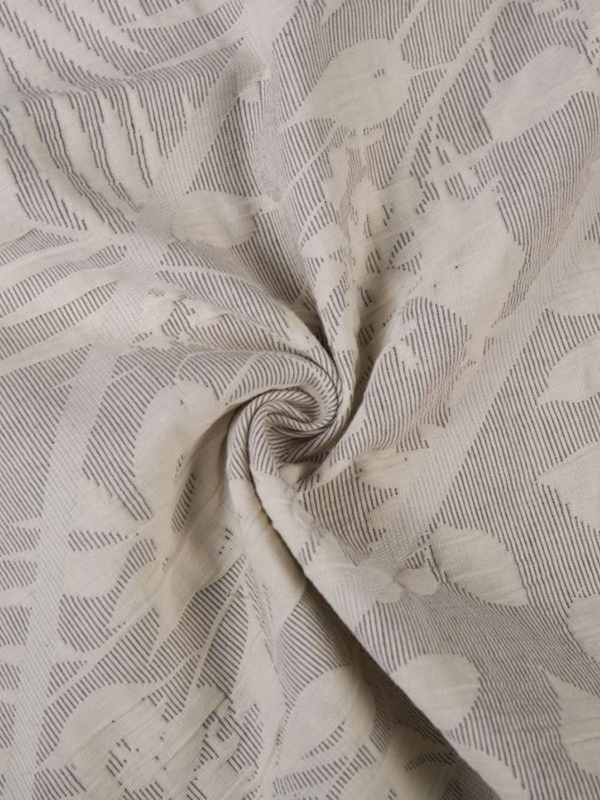
- Matelassé: A double-cloth jacquard construction that creates a puckered, quilted, or embossed surface appearance through the selective bonding and separation of two woven layers. The resulting fabric has a padded, three-dimensional quality without any actual wadding, achieved purely through woven structure.
- Figured Velvet: A cut-pile jacquard where the pile is selectively cut or left uncut in different zones to create a pattern of contrasting textures and heights across the velvet surface — one of the most technically complex jacquard constructions and historically among the most prestigious textiles produced.
Brocade vs Jacquard Fabric: Understanding the Real Relationship
The comparison between brocade and jacquard fabric is one of the most commonly misunderstood distinctions in textile terminology, largely because the two terms are used interchangeably in retail markets and fashion descriptions. The accurate relationship between them is straightforward: all brocade is jacquard fabric, but not all jacquard fabric is brocade. Brocade is a specific type of jacquard textile, defined not just by the use of a Jacquard loom but by a particular construction technique that involves supplementary weft threads woven into the ground fabric to create raised, ornamented surface motifs.
In a standard jacquard fabric such as damask, the pattern is formed entirely by the ground weave threads — the same threads that form the cloth structure also form the pattern by interlacing differently in different areas. In brocade, additional weft threads — the supplementary or "brocading" threads — are introduced specifically and solely for the purpose of creating the decorative pattern. These threads float across the back of the fabric in areas where they are not part of the visible design, and they appear on the face only where the pattern calls for them. This supplementary thread technique produces the characteristic raised, embossed, or jewel-like quality of brocade motifs that cannot be achieved through ground weave variation alone.
Structural Differences Between Brocade and Other Jacquard Fabrics
The supplementary weft threads in brocade are not anchored into the fabric structure at every point along their length — they float freely across the back of the cloth between their points of interlacement on the face. This floating construction means that brocade fabrics are generally less suitable for applications involving heavy mechanical stress, repeated flexing, or abrasive contact, since the supplementary thread floats can snag, pull, or distort more easily than the tightly bound threads of a plain or twill jacquard ground weave. This structural characteristic influences where brocade is used and how it should be cared for in practical applications.
Side-by-Side Comparison: Brocade vs Jacquard Fabric
| Feature | Jacquard Fabric (General) | Brocade |
| Production Method | Jacquard loom, ground weave variation | Jacquard loom with supplementary weft threads |
| Pattern Formation | Weave structure changes within ground threads | Supplementary threads added above ground weave |
| Surface Texture | Relatively flat, tonal contrast | Raised, embossed, three-dimensional motifs |
| Back of Fabric | Clean reverse of face pattern | Floating threads visible on reverse |
| Weight and Hand | Wide range — light to heavy | Generally heavier due to extra threads |
| Typical Fibers | Cotton, polyester, silk, wool, blends | Silk, metallic thread, satin-based yarns |
| Durability | High, depending on fiber | Moderate — floats can snag |
| Cost | Moderate to high | High to very high (especially silk brocade) |
| Common Uses | Apparel, upholstery, home textiles | Formal wear, ceremonial textiles, drapery |
Fiber Content and Its Impact on Jacquard Fabric Quality
Because jacquard is a weaving method rather than a material category, jacquard fabrics can be produced from virtually any yarn type — and the fiber content has an enormous influence on the final fabric's hand feel, drape, luster, durability, and price. Silk jacquards are among the most prized textiles in the world, combining the fiber's natural luster and smooth hand with the complex patterning achievable through Jacquard weaving to produce fabrics of extraordinary visual richness. Silk damask and silk brocade have been luxury status symbols across cultures for centuries, historically reserved for royalty, religious vestments, and the highest levels of ceremonial dress.
Cotton jacquard fabrics offer the accessibility, washability, and breathability of cotton in patterns of considerable complexity — making them the dominant choice for jacquard table linens, bed covers, and everyday fashion apparel. Polyester and polyester-blend jacquards have dramatically expanded the commercial availability of jacquard-patterned fabrics at accessible price points, enabling the production of vibrant, color-fast patterns with good dimensional stability and easy care. Viscose and rayon jacquards offer a silky drape and subtle sheen at mid-range price points, making them popular in fashion apparel and accessories. Wool jacquards — particularly in double-cloth or tapestry constructions — provide warmth, body, and durability suited to outerwear and upholstery applications.
Practical Applications: Where Jacquard and Brocade Fabrics Are Used
The application range for jacquard fabrics is exceptionally broad, spanning apparel, home furnishings, accessories, and industrial textiles. The specific characteristics of each jacquard type — weight, fiber, weave complexity, and surface texture — determine its suitability for particular end uses, and matching the right jacquard construction to the right application is critical to achieving both aesthetic and functional success.
Apparel and Fashion
In fashion, jacquard fabrics are used across a spectrum from casual to haute couture. Lightweight jacquard knits and wovens appear in contemporary ready-to-wear collections as structured jackets, skirts, and trousers that offer visual interest without surface embellishment. Heavier brocades and jacquard damasks are used in formal eveningwear, bridal gowns, and traditional ceremonial dress across many cultures — including Indian wedding lehengas, Chinese qipaos, and Western ball gowns — where the fabric's inherent richness is a core element of the garment's value and significance. Jacquard accessories including scarves, ties, handbags, and belts exploit the fabric's pattern fidelity and structural stability in smaller-format applications where quality and detail are closely scrutinized.
Home Furnishings and Upholstery
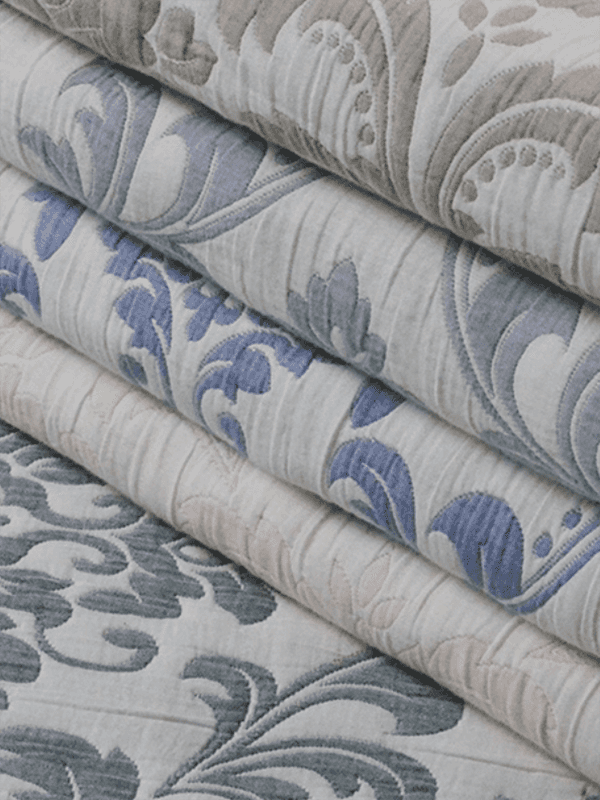
Jacquard fabrics are among the most widely used textile categories in interior design and home furnishing. Tapestry jacquards and matelassé constructions are standard upholstery fabrics for sofas, chairs, and ottomans where their dense weave structure, dimensional stability, and abrasion resistance make them functionally suited to heavy-use furniture applications. Damask jacquards are the traditional choice for drapery and curtaining in formal interior schemes, while lighter jacquard constructions in cotton or linen blends serve as decorative throw pillow covers, bedding, and table textiles. The pattern durability of woven jacquard — which will not fade, rub off, or crack over time as printed or surface-coated alternatives might — makes it a sound long-term investment in furnishing applications.
How to Identify Genuine Jacquard Fabric When Buying
As jacquard-patterned aesthetics have become more commercially popular, it has become increasingly common for printed fabrics — particularly polyester prints designed to mimic the visual effect of woven jacquard — to be marketed using jacquard terminology. Knowing how to distinguish a genuinely woven jacquard from a printed imitation helps buyers make informed decisions and ensures they receive the durability, tactile quality, and pattern integrity that characterize authentic jacquard textiles.
- Examine the reverse side: In a genuine jacquard fabric, the pattern structure is visible — if often in reverse or negative — on the back of the cloth. In a printed fabric, the reverse side will show the plain base cloth with little or no visible pattern coloration.
- Feel for surface texture variation: Authentic woven jacquards have a tactile surface relief — different zones of the pattern feel different because they have different weave structures with different numbers of yarn floats. Printed fabrics have a uniformly flat surface regardless of pattern complexity.
- Check color penetration on cut edges: In woven jacquard, colored yarns run continuously through the fabric structure and are visible when the cloth is cut. In a printed fabric, color sits primarily on the surface and the cut edge will show the undyed base yarn.
- Look for floating threads on brocade reverse: Genuine brocade will show supplementary weft threads floating across the fabric back in a regular pattern corresponding to the motifs on the face. This is a definitive indicator of authentic brocade construction that cannot be replicated in a printed or embroidered imitation.
- Test washfastness: Woven jacquard patterns are completely washfast because they are structural — the color is in the yarn, not on the surface. If a "jacquard" fabric bleeds color or shows any pattern fading after gentle washing, it is almost certainly a printed textile.
Care and Maintenance of Jacquard and Brocade Fabrics
Proper care of jacquard fabrics depends primarily on fiber content and construction weight rather than on the jacquard weaving method itself. Cotton and polyester jacquards are generally machine washable on gentle cycles with mild detergent, though higher-count constructions benefit from mesh laundry bags to minimize mechanical stress on the surface. Silk jacquards and brocades should always be dry cleaned or hand washed in cold water with extreme care — silk fibers are weakened by heat and mechanical agitation, and the supplementary thread floats in brocade are vulnerable to snagging on machine drum surfaces or other garments.
Ironing jacquard fabrics requires attention to temperature settings appropriate for the fiber content and a pressing cloth to protect the woven surface. Pressing brocade directly with a hot iron can crush the raised supplementary thread motifs and permanently damage the fabric's distinctive three-dimensional character. Storage of valuable jacquard and brocade textiles — particularly silk pieces — should be in acid-free tissue or breathable garment bags, laid flat or loosely rolled rather than folded sharply, since sharp fold lines can create permanent crease damage in the structured weave over time. With appropriate care, high-quality jacquard and brocade fabrics are among the most durable and long-lived textile investments available, retaining their pattern clarity and structural integrity for decades of careful use.